

A Pure-Vegetarian Food Guide to Darjeeling
Darjeeling’s food culture runs on warm soups, filled dumplings and hot tea, and most menus in town mix vegetarian and non-vegetarian cooking in the same kitchen. That’s fine if you eat everything, but strict vegetarians need to know which dishes are naturally meat-free, which restaurants are genuinely pure vegetarian, and which well-known spots just offer a few veg options on a meat-heavy menu. Getting that distinction right makes meal planning far easier when exploring Darjeeling.

Vegetarian Dishes to Know
Local hill cuisine draws on Nepalese, Tibetan and broader Indian traditions, and many staples are vegetarian, or easily made so. The Tibetan strand traces to a real community: the Tibetan Refugee Self-Help Centre at Lebong, set up by refugees on 2 October 1959 after they followed the Dalai Lama out of Tibet, whose main activity today is handicrafts.
Momos
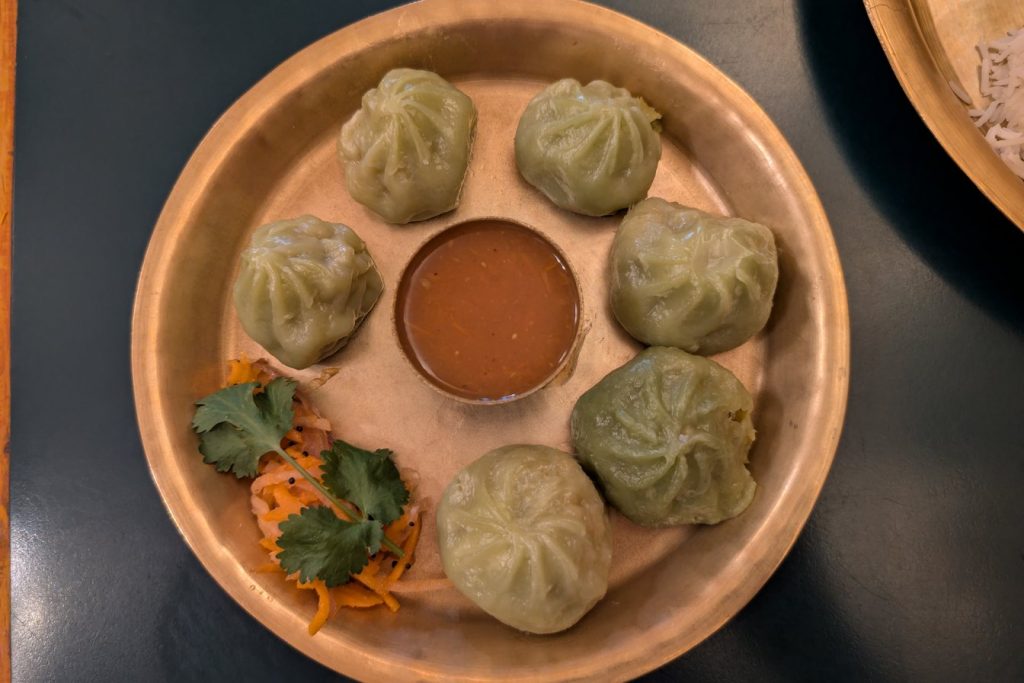
Momos are steamed, pan-fried or deep-fried dumplings of Nepalese and Tibetan origin, eaten across the wider eastern Himalayas as an everyday meal or snack, usually with a spicy tomato-based dip called achaar, often made fiery with dalle khursani, the small round hill chilli that carries its own Geographical Indication covering Sikkim and West Bengal. Vegetarian fillings typically include cabbage, carrot and potato, textured soy granules, flat bean or chayote, and paneer or soft chhurpi cheese.
Thukpa
Thukpa is a noodle soup that originated in eastern Tibet and is eaten throughout Nepal and Darjeeling — the word covers a family of noodle soups, including thenthuk (flat, hand-pulled noodles). Vegetarian versions swap chicken for beans, chickpeas, gram or kidney beans, so it’s worth stating your preference at a mixed stall.
Churpi and Sel Roti
Churpi (also chhurpi) is a traditional fermented cheese made from yak or cow’s milk, eaten across Nepal, Bhutan, Tibet and the Darjeeling hills. Soft churpi goes into cooking and dumpling fillings; hard churpi is dried into blocks and chewed like gum.
Sel roti is a ring-shaped, sweet, deep-fried bread of rice-flour batter with sugar, ghee and spices, traditional across Darjeeling, Kalimpong, Sikkim, Kumaon and Nepal, served especially at weddings and during Dashain and Tihar.
Sinki, Kinema and Gundruk
Beyond the familiar dishes, the hills have a genuine tradition of naturally vegetarian fermented foods, documented by Prof. Jyoti Prakash Tamang of Sikkim University. Sinki is fermented radish tap root, not the leaves, eaten as a soup base and pickle; a 1993 paper by Tamang and Sarkar describes a non-salted product taking twenty to thirty days to ferment. Kinema, the fermented soybean dish, is estimated in Tamang’s research to date roughly 600 BC–100 AD, introduced by the Limbu people. Gundruk, from mustard, radish and cauliflower leaves harvested in October and November, is wilted, shredded and packed into a warm-water earthenware pot for about a week to sour, then sun-dried, with no salt unlike sauerkraut or kimchi.
Darjeeling Tea
Tea remains central to how the region eats and drinks. Commercial plantations here date from 1841, and tea is woven into the area’s social and cultural life, served black or with milk alongside most meals. On Laden La Road — the same street as the hotel — Nathmull’s Tea was founded in 1931 by Nathmull Sarda, a trader from Rajasthan, per the company’s account.
Pure Veg vs Mixed Kitchens: Getting the Distinction Right
Travel guides often blur the line between restaurants that are genuinely meat-free and popular cafes that simply carry a few vegetarian dishes on a mixed menu. For strict vegetarians, that distinction matters more than the food itself.
Restaurants That Are Genuinely Pure Vegetarian
- Hasty Tasty, on Nehru Road, is categorised by local tourism sources as exclusively vegetarian, serving North Indian, South Indian, Punjabi, Gujarati and vegetarian Chinese dishes, plus pizzas — an established option near Chowrasta that caters to Jain needs.
- Kasturi Palace Restaurant, on Hill Cart Road inside Hotel Kasturi Palace, is listed under “pure vegetarian restaurants” by local tourism directories, specialising in Gujarati, Jain, Marwari and South Indian food — dal makhani, mixed vegetables, palak paneer.
- Grains Pure Veg, run by Udaan Hotels & Resorts with branches at the Udaan Himalayan, Udaan Nirvana and Udaan Maitree properties, is explicitly branded pure vegetarian and accommodates Jain requests.
- Lunnar Restaurant, on Gandhi Road, is also categorised as pure vegetarian by local tourism directories, serving North Indian, South Indian and Chinese food.
Well-Known Names That Are NOT Pure Vegetarian
- Keventer’s, founded in 1911 on Nehru Road near Mall Road, is not pure vegetarian. Its menu includes pork dishes — fried and smoked sausages, bacon, ham, a cold platter of smoked and cooked ham with salami, plus a sausage-bacon-ham-and-eggs combo — alongside chicken items. It does have vegetarian options (vegetable burger, cheese sandwich, cheese hotdog, fries, baked beans, toast, cornflakes), so it’s vegetarian-friendly, but never a pure veg restaurant.
- Glenary’s, also on Nehru Road, was founded in 1885 as a confectionery called “Vado” (one 2023 article separately described it as 135 years old, which would put it closer to 1888 — sources differ by a few years). It is not pure vegetarian either: alongside a substantial vegetarian menu — paneer matar, sahi paneer, corn palak paneer, paneer chilli, vegetable pakodas, veg manchurian, sweet and sour vegetables, crispy fried potatoes — the kitchen also serves Continental, Indian and Chinese dishes with tandoori meats, steaks and fish.
- New Kalika Restaurant, in Chauk Bazaar at Old Club Side, is a case to be careful with: one tourism listing calls it purely vegetarian, but the same source recommends its chicken momos, and customer accounts mention chicken momos and chicken thukpa too — a direct contradiction, so ask staff directly before ordering.
Staying and Eating Pure Vegetarian at Hotel Apsara
If you’d rather not navigate that pure-veg-versus-mixed-kitchen question at every meal, staying somewhere pure vegetarian removes the guesswork. Hotel Apsara, at 6 Laden La Road, Chauk Bazaar, Darjeeling, West Bengal 734101, near the Head Post Office in Darjeeling Bazar, is one such option — a few minutes’ walk from Mall Road and 270 m from Keventer’s.
The hotel runs its own multi-cuisine vegetarian restaurant, serving Indian vegetarian food prepared by an Indian chef, with a kid’s menu. Room service is available, though only for limited hours. Breakfast is a paid add-on, currently ₹150 — worth confirming, since this was checked in September 2026 and could have changed.
Guests can choose from six room types, with published rates from ₹3,723 to ₹6,585 a night — indicative figures, not a guarantee. Among them, the Super Deluxe Room is listed at ₹5,742 per night. See the full range of rooms before deciding where to stay.