

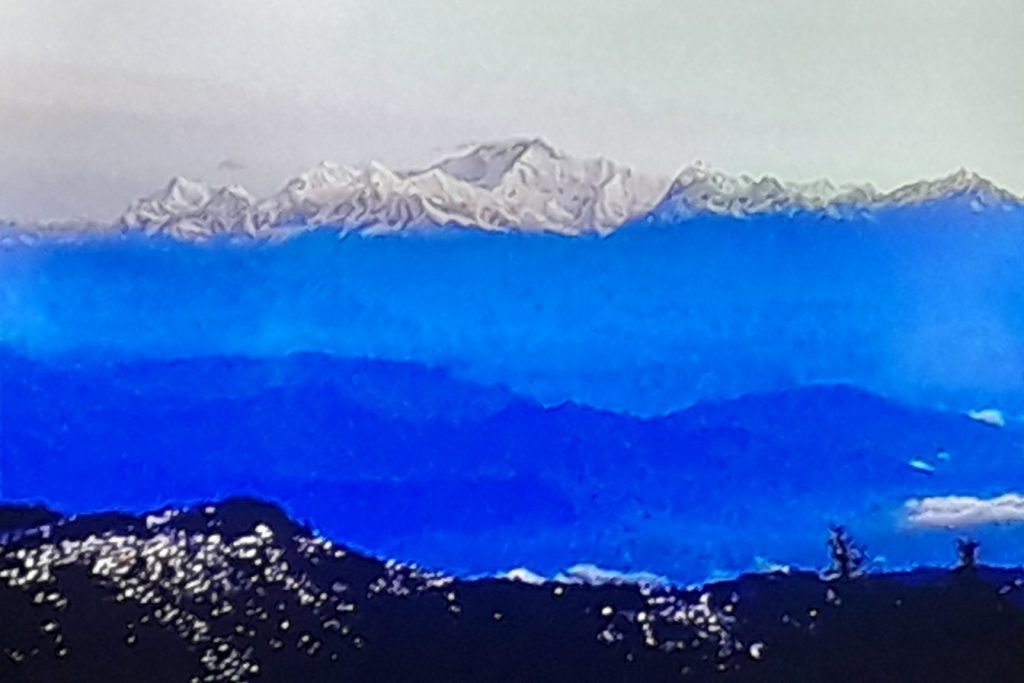
Almost everyone who visits Darjeeling is told to set an alarm for the middle of the night to watch dawn break over the Eastern Himalayas. The Tiger Hill sunrise is Darjeeling’s most famous morning excursion, drawing travellers into the dark to watch sunlight strike the high peaks before it reaches the valleys below. It is impressive when conditions are clear, but getting up the ridge smoothly takes some practical preparation, not just an early alarm.
A quick note before the detail below: fares, permit rules and ticket prices for Tiger Hill were checked in September 2026 and change often. Confirm the current figures locally before you travel.
What Tiger Hill actually is: altitude, distance, and the view
Tiger Hill is a high ridge at approximately 2,590 metres (8,400–8,500 feet, sources vary slightly) above sea level — significantly higher than Darjeeling town, whose official elevation is 2,042 metres (6,700 feet) per the district government website, one reason the summit feels so much colder before dawn.
Sources put the distance from town anywhere from about 5 km (from Chowrasta) to an outlying 22 km; take the most commonly cited figure, 11 km, as your working number and confirm locally.
The main draw is the Kanchenjunga view from Tiger Hill. Kangchenjunga stands at 8,586 metres (28,169 feet), the world’s third-highest mountain after Everest and K2. On clear mornings its snow face catches the first light while the valleys below stay in shadow, and the colour shifts as the sun climbs.
You will also hear claims that Everest is visible from here. The Darjeeling district administration’s own tourism page addresses this directly: the straight-line distance from Tiger Hill to Everest is given as 107 miles (172 km), and Kangchenjunga only looks higher than Everest because it sits several miles closer — an effect of the Earth’s curvature, not of actual height. The same page also lists Kurseong town, the Teesta, Mahananda, Balason and Mechi rivers, and Chumal Rhi mountain in Tibet, 84 miles (135 km) away across the Chola Range, as visible on a clear morning. An Everest sighting remains a long shot — Kangchenjunga, several miles closer and squarely in view, is the real reason to make the trip.
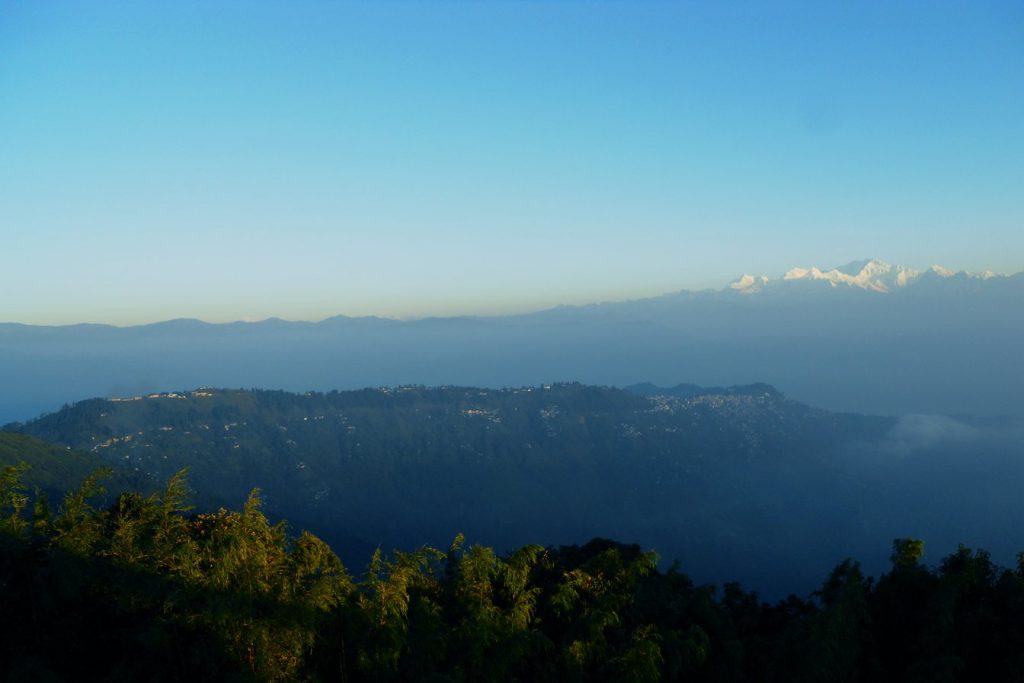
Senchal Wildlife Sanctuary and the return route through Ghum
Tiger Hill sits on the edge of Senchal Wildlife Sanctuary — one of India’s oldest wildlife sanctuaries, per the Darjeeling district administration’s own tourism pages: 38.6 sq km, spanning 1,500 to 2,600 metres, recorded as established in 1915. Inside it, the North and South Senchal lakes, built by the British as Darjeeling’s first water-supply system between the early 1900s and 1916–17 and fed by springs within the sanctuary, remain the town’s main source of drinking water.
Most sunrise trips loop back via Ghum, and the standard stop is Ghum Monastery — the Yiga Choeling Monastery, Gelukpa (Yellow Hat) sect, about 8,000 feet up and 8 km from Darjeeling — established in 1850 by the Mongolian monk Sokpo Sherab Gyatso, who headed it until 1905. Inside stands a 15-foot statue of the Maitreya Buddha, made of clay brought from Tibet, commissioned under Kyabje Domo Geshe Rinpoche, who led the monastery 1910–1952. Ghum’s railway station, on the line below, sits at roughly 2,258–2,260 metres; the railway reached Ghum on 4 April 1881.
Getting there and the vehicle permit system
A tiger hill permit is mandatory for any vehicle driving up the ridge. Permits are issued by the district or Sadar Traffic Police, not the tourism department, and must be collected in person, one day in advance, from the Sadar Traffic Office at Chowk Bazaar — first-come, first-served. This system was documented in a 2019 report and still appears to operate the same way, though no online booking portal could be found.
Permit quotas are limited, but cited figures conflict, ranging roughly 300 to 600 vehicles a day; treat any number as indicative and check locally.
Transport fares vary widely by source and season: one source lists a shared jeep at around ₹150 per head and a private car at ₹800; others report shared-jeep fares of ₹300–400 per person and private taxis from ₹1,200 to ₹3,500.
Sunrise falls roughly between 4:45 AM and 5:30 AM depending on the month. Visitors typically leave Darjeeling between 3:15 AM and 4:00 AM — earlier in summer, later in winter — so check nearer your date. The viewpoint is open 4:00 AM to 6:00 PM.
Entry fees and the observatory tower
Entry comes in two parts. Personal entry to the viewpoint is disputed — one source says free, another gives roughly ₹50–100 per person, “subject to change” — so confirm on arrival.
There is also a multi-level observatory tower on the summit; standing outside in the open is free, but inside, tiered pricing applies:
- Ground floor: ₹20
- First floor: ₹30
- Third (top) floor: ₹40
Telescope use costs roughly ₹50 extra.
Best time of year to see Tiger Hill sunrise
The best time to see Tiger Hill sunrise is the post-monsoon window, October to December, when skies are consistently clearest; some sources extend the favourable window to February–April. June to September, the monsoon months, bring persistent cloud and rain, and the peaks are rarely visible.
What to expect on the ridge
A few practical points worth knowing before you go:
- Dress for real cold. At close to 2,590 metres before dawn, the ridge is much colder than the town below — bring a warm jacket, a cap and gloves.
- Expect company. Tiger Hill sunrise is one of Darjeeling’s best-known excursions and the viewpoint gets busy, especially October to December. Do not expect to have the railings to yourself.
- Keep your expectations flexible. Mountain weather changes quickly, and even in good months cloud can roll in and block the view, so a clear sunrise is never guaranteed.
Where to stay before an early Tiger Hill start
A sunrise trip means leaving town between 3:15 AM and 4:00 AM, so a straightforward, central base helps. Hotel Apsara is a pure vegetarian hotel at 6 Laden La Road, Chauk Bazaar, Darjeeling 734101, near the Head Post Office in Darjeeling Bazar — a few minutes’ walk from Mall Road (MakeMyTrip’s own figure: roughly 470 m, a 6-minute walk) — and MakeMyTrip records the driving distance to Tiger Hill as 13.4 km.
Two things matter most for a 3 AM start: the reception runs 24 hours, so someone can see you off and let you back in, and guests can book the private-taxi transfer through the hotel’s own paid transfer and shuttle service rather than sourcing a driver independently. Before or after your trip, the hotel’s multi-cuisine vegetarian restaurant serves Indian vegetarian food prepared by an Indian chef, with a kid’s menu available.
Check-in is at 1:00 PM; check-out is unsettled across sources (11:30 AM and 12:00 PM both appear), so confirm when you book. Six room types are listed, the Super Deluxe Room with Mountain View among them, with published indicative rates of ₹3,723–₹6,585 a night — treat as a guide and confirm for your dates.
For a central base close to the viewpoint and a few minutes’ walk from Mall Road, Hotel Apsara is a reasonable starting point for your morning up Tiger Hill.