

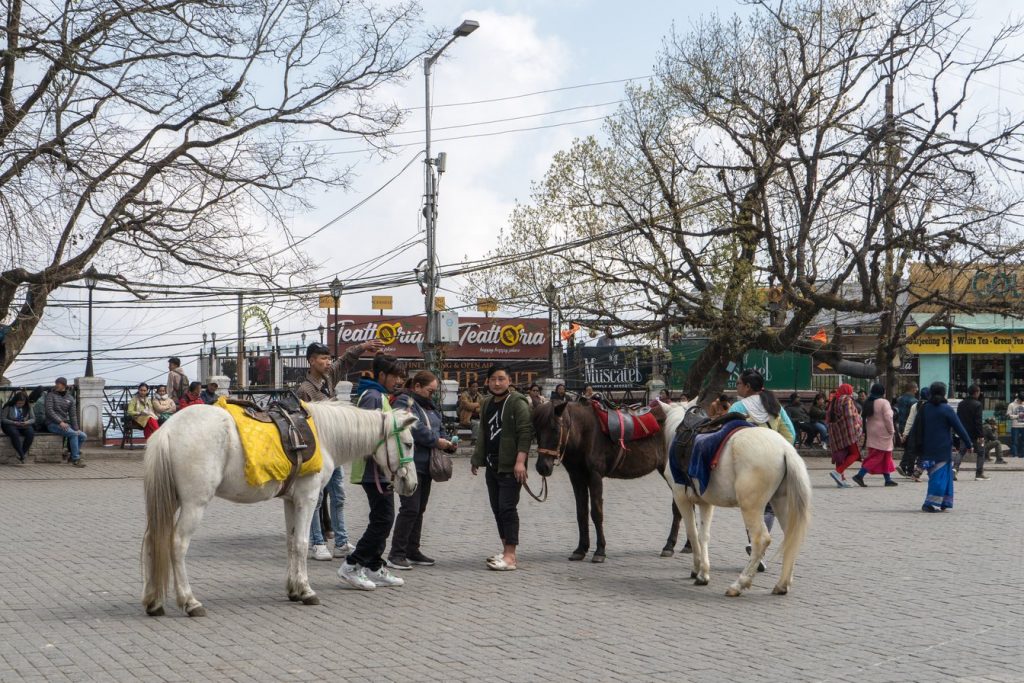
Mall Road and Chowrasta: Darjeeling’s Heart
Chowrasta is the central public square on the uppermost ridge of Darjeeling. The name translates to “four roads”, marking the junction where Nehru Road, Mall Road and Zakir Hussain Road meet. Mall Road itself loops around the nearby hillside. It is the main focal point of social life in the hill station.
Unlike the lower tiers of town, with their regular traffic and crowded market lanes, Chowrasta and Mall Road are closed to general vehicular traffic — only pedestrians and pony rides are normally permitted. (Enforcement lapses locally at times, so this is the norm rather than an absolute guarantee.)
Elevation and Geography
Chowrasta sits at approximately 2,134 m (7,001 ft), the town’s highest terrace; the official district administration records Darjeeling’s general average elevation at 2,042 m (6,700 ft).
Sitting on this upper ridge, Chowrasta gives open views across the valleys on clear days. Mall Road splits into two branches at the square that circle Observatory Hill and rejoin at Chowrasta, forming a loop around the summit.
History and Colonial Origins
Darjeeling’s development as a hill station began in 1828, when Captain G.A. Lloyd and J.W. Grant, the East India Company’s commercial resident at Malda, picked out this ridge for a sanatorium town. In 1835 the Company took a grant deed from the Chogyal of Sikkim, Tsugphud Namgyal, for a strip of land roughly 40 km by 10 km — the ground Chowrasta stands on. Lloyd organised the road-building labour before being replaced by Surgeon Major Archibald Campbell, previously assistant resident in Nepal, given wide powers as superintendent. In 1849 Campbell and the botanist Joseph Dalton Hooker were briefly held captive by a faction of the Sikkim court, ending in a threatened British invasion and the annexation of some 1,700 sq km between the Mechi and Teesta rivers. Darjeeling became a municipality in 1850, fifteen years after the grant.
Chowrasta and Mall Road took shape here as this administration grew, giving officials a promenade away from the working bazaar below. The benches, paved court and bandstand that remain today reflect that period’s planning.
Landmarks on and around the square
Landmarks and shops line the square’s borders.
The Bhanubhakta Acharya Statue
Near the entrance to the square stands a golden statue of Bhanubhakta Acharya, the nineteenth-century Nepali poet. His Nepali rendering of the Ramayana is widely considered the first Nepali epic, though not a strict word-for-word translation of the Sanskrit — he read and absorbed the original, then rendered the story independently in Nepali verse ordinary people could follow. An earlier statue is said to have stood here from 1949; the present figure was reinstalled in 1996.
The Hawa Ghar
Along one side of the square stands the Hawa Ghar, a roofed bandstand with an open stage.
Oxford Book & Stationery Co.
Among the shops facing the square, Oxford Book & Stationery Co. is one of the oldest, having operated there for decades.
Fountain and Pigeon-Feeding Area
An ornamental fountain, now dry, sits near the centre of the square, next to a pigeon-feeding area. Independent cafes, restaurants and hotels line the rest of the square.
Where Deshbandhu C.R. Das Died
Deshbandhu Chittaranjan Das, the Bengali nationalist leader, died in Darjeeling on 16 June 1925 at “Step Aside”, the house of Sir N.N. Sircar; Gandhi had stayed with him here for some days beforehand.
The Darjeeling Club
The town also has the Darjeeling Club, long known as the Planters’ Club, whose roughly 1.99-acre grounds were originally leased from the Maharaja of Cooch Behar; members campaigned from 2011 to 2020 to have it declared a heritage property.
Walking Nehru Road
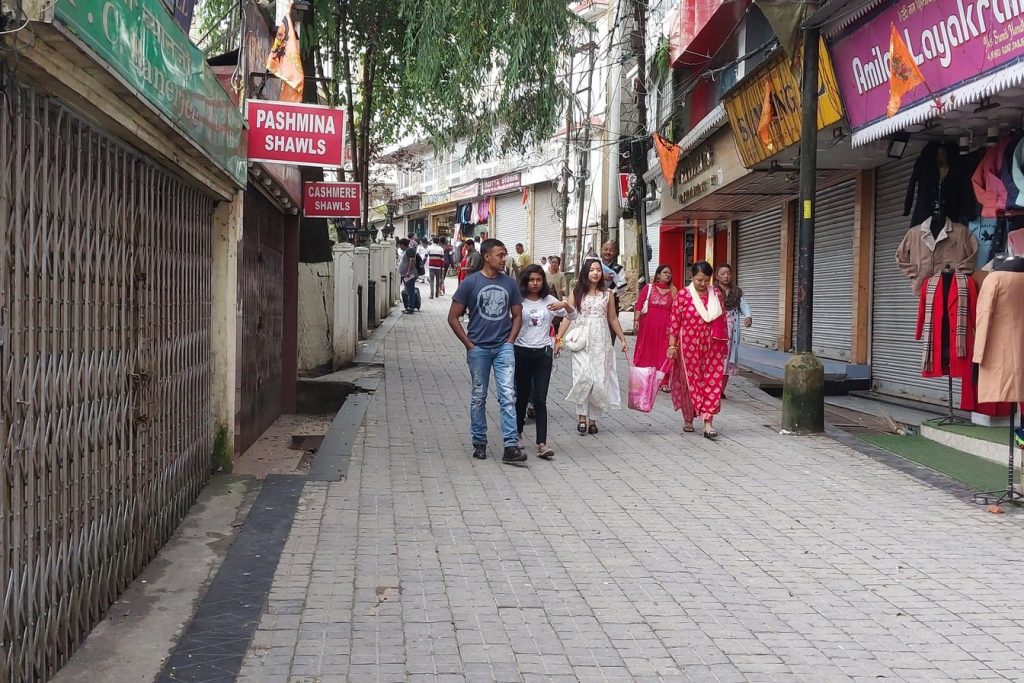
Nehru Road is the main pedestrian route up to Chowrasta, starting near Gandhi Road and climbing steadily into the square. Built in the colonial era, the street was later named for Jawaharlal Nehru, India’s first Prime Minister, and is lined today with shops selling tea, woollens, brass crafts and curios. It’s the direct walking link between the bazaar tiers and the square, so foot traffic here stays steady through the day.
Observatory Hill and Mahakal Temple
Rising above Chowrasta is Observatory Hill, the oldest inhabited and venerated site in town.
Before urban development, it was an indigenous sacred site for the local Lepcha community. In 1765, a Buddhist monastery called “Dorje-Ling” was founded on the summit by Lama Dorje-Rinzing. In 1815, during regional conflict, the monastery was sacked in a Gorkha invasion. It was rebuilt in 1861, and in 1879 it was moved to its present site at Bhutia Busty, where it stands today.
Mahakal Temple
At the top of the hill stands Mahakal Temple, founded in 1782 by Lama Dorjey Rinzing. It’s an active example of Hindu-Buddhist blending: a Hindu priest and a Buddhist monk conduct daily prayers side by side within the central compound. The main sanctum holds three gold-plated lingams representing Brahma, Vishnu and Maheshwar (Shiva).
Darjeeling’s name is generally traced to “Dorje-Ling”, a reference to this hill and its monastery. Academic accounts go a step further: the settlement grew up on the site of an indigenous Lepcha village already called Dorje-ling before the British arrived. The precise linguistic roots are still debated, but the Lepcha village is the better-documented starting point.
Things to Do at Chowrasta
The square moves at an unhurried pace compared to the lower town.
- Walk the Mall Road loop: an unhurried walk around Observatory Hill, past trees and mountain slopes, largely free of motor traffic.
- Pony rides: offered along Mall Road and Chowrasta, mostly for children, with handlers guiding the animals by rein. Fares aren’t fixed — settle the price first.
- Read and browse: Oxford Book & Stationery Co. is worth a stop for regional titles hard to find elsewhere.
- Watch the square: rows of public benches face onto the flagstones, giving an unhurried view of daily hill-town life.
- Getting there on foot: taxis can’t set down directly at Chowrasta since vehicles are restricted, and the climb up Nehru Road or Laden La Road is steady, so wear comfortable shoes.
Food and Dining Around the Mall
A few historical eateries sit around Chowrasta and along Nehru Road.
Keventer’s
Near the junction of Nehru Road and Mall Road, Keventer’s is a long-standing food stop founded in 1911. Vegetarian travellers should note it is not a pure vegetarian establishment — alongside its vegetarian items, the menu includes pork preparations such as sausages, bacon and ham.
Glenary’s
Further down Nehru Road, Glenary’s is a heritage bakery and restaurant. It was founded in 1885 as a confectionery called “Vado”, according to the best-sourced figure, though one independent travel article from 2023 described it as 135 years old — which would put its founding closer to 1888. Sources vary by a few years on the exact date. Glenary’s, too, is not a pure vegetarian venue: alongside a varied vegetarian menu, the kitchen prepares Continental, Chinese and Indian dishes that include tandoori meats, steaks and fish.
Staying Near Mall Road at Hotel Apsara
For travellers who keep to pure vegetarian dining, staying close to the pedestrian zone simplifies meals. Hotel Apsara, a pure vegetarian property at 6 Laden La Road, Chauk Bazaar, Darjeeling, near the Head Post Office in Darjeeling Bazar, is a few minutes’ walk from Mall Road — and 270 m, about three minutes, from Keventer’s on Nehru Road.
Guests can eat at the hotel’s multi-cuisine vegetarian restaurant, which serves Indian vegetarian food prepared by an Indian chef, with a dedicated kid’s menu.
For accommodation, browse Hotel Apsara’s rooms across six room types, with published indicative rates from ₹3,723 to ₹6,585 per night. Among them, the Deluxe Room is listed at ₹4,455 per night. You can also browse the hotel’s photo gallery to see the property before you arrive.