

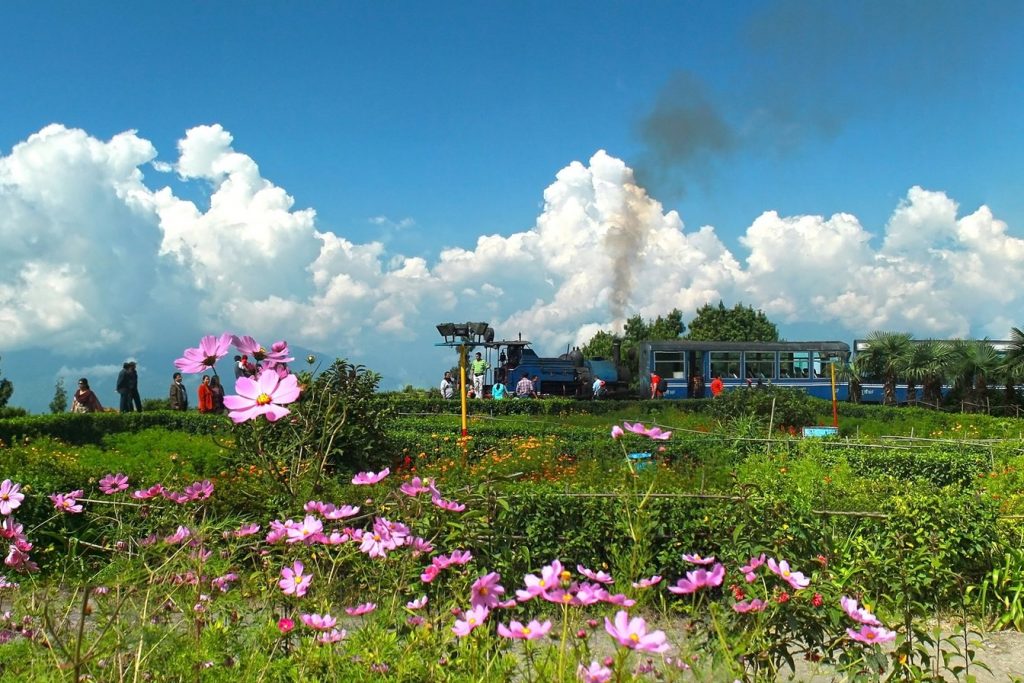
Most people who come up to Darjeeling have Batasia Loop on their list, and with good reason. It is one of the most familiar landmarks along Hill Cart Road, sitting high on the ridge where the narrow-gauge railway sweeps around an open, terraced garden. It is not an isolated wilderness spot — it is an active railway loop with a landscaped garden and a military memorial at its centre — but the view across the hills and the sight of a steam train negotiating the bend make it worth an hour of your morning.
A quick note before the detail below: opening hours, entry fees and dates for Batasia Loop were checked in September 2026 and can change. Confirm current figures locally before you travel.
What Batasia Loop is
Batasia Loop is part of the Darjeeling Himalayan Railway, inscribed by UNESCO as a World Heritage Site on 2 December 1999, under criteria (ii) and (iv), with an 88.99-hectare core property and a 644.88-hectare buffer zone. UNESCO describes the line, opened in 1881, as the first, and still one of the most outstanding, examples of a hill passenger railway. The name Batasia is generally translated as a “windy” or “airy” place — the district government’s own tourism page glosses it as “(A Windy Place).”
To manage the gradient, UNESCO’s own description of the railway’s engineering points to six zigzag reverses and three loops, at a ruling gradient of 1:31, reaching an altitude of 2,258 metres — the same band, roughly 7,400 feet, in which Batasia Loop itself sits. Batasia Loop is one of those three loops, and railway histories date its construction to 1919, nearly forty years after the line first reached Darjeeling. Instead of taking the line straight down the mountainside, engineers routed the track into a spiral, the toy train circling a central garden and crossing back over its own alignment before continuing toward Darjeeling. The district government’s own page for the loop describes the train as descending 1,000 feet in altitude “almost imperceptibly” on this stretch.
Because it occupies a prominent shoulder of the hill, the site offers views across the surrounding valleys. Inside the perimeter of the tracks, the railway maintains a landscaped garden of about 50,000 square feet, planted with seasonal and perennial flowers, shrubs and trees, giving visitors a pleasant space to walk while waiting for the train.
The Gorkha War Memorial
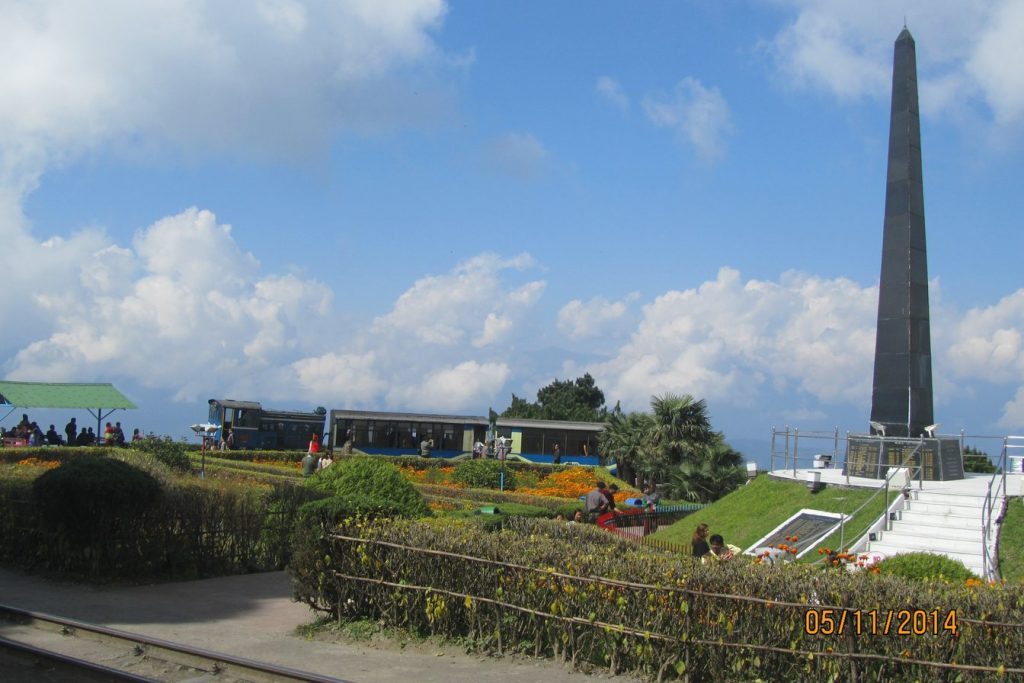
At the centre of the garden stands the Gorkha War Memorial Darjeeling. While many visitors come for the novelty of the railway loop, the monument gives the site a more solemn weight.
The memorial was raised by the District Sainik Board, Darjeeling, for Gorkha soldiers of the Indian Army who died defending the country’s sovereignty after independence in 1947. One source records that over 75 soldiers are individually named on it. On the unveiling date the official district record gives 22 March 1995, when the memorial was “sanctified”; one other account gives 18 April 1995.
Regional tourism accounts describe the memorial’s physical form as a triangular granite cenotaph carrying a roll of honour of the dead, with a bronze statue of a Gorkha soldier — about three metres high — standing beside it.
Visiting — hours, entry fee, getting there
Batasia Loop is open from 6:00 AM to 5:00 PM daily, including Sundays.
Published entry-fee figures disagree: one source gives ₹15 per person, another, more commonly cited, ₹20. Carry change and check the board at the gate; if you arrive on a ticketed toy-train joy ride, there is no separate entry fee.
The official district government website puts Batasia Loop about 5 km ahead of Darjeeling town; some secondary guidebooks give a slightly lower 4.3 km — take 5 km as your working figure. Coming from Ghum, the loop sits on the rail line between Ghum and Darjeeling, described by several sources as just below Ghum station, though none gives a confirmed kilometre figure for that stretch; treat it as the next rail landmark after Ghum.
For those travelling by road, a taxi from Darjeeling town is the usual way to reach the loop.
Seeing it by toy train vs by road
Travellers often wonder whether it is better to see Batasia Loop from the carriage of the toy train or by visiting on foot from the road. They give two different experiences.
Riding the Darjeeling Himalayan Railway toy train lets you feel the engineering from the rails. The standard Darjeeling–Ghum joy ride runs as a round trip of roughly two hours, with a scheduled stop of about 10 minutes at Batasia Loop — enough to step onto the platform, walk over to the memorial and take a few photographs before the engine whistles for boarding, so you will need to move at a reasonable pace.
Visiting by road gives you more control over your time — you pay the entry fee at the gate and can sit in the garden or walk the paths at leisure. Being outside also lets you watch the train itself: seeing the locomotive steam into the loop and circle the garden from outside gives a clearer sense of how the loop works than looking out from inside a carriage. If your schedule allows, doing both — riding the joy ride once and visiting separately by road — gives the fullest picture.
Where to stay near Batasia Loop
If you want to visit Batasia Loop early without a long drive, staying centrally in Darjeeling is the practical choice. Hotel Apsara is a pure vegetarian hotel at 6 Laden La Road, Chauk Bazaar, Darjeeling, West Bengal 734101, near the Head Post Office in Darjeeling Bazar.
By road, the driving distance from the hotel to Batasia Loop is 4.4 km, per MakeMyTrip. If you plan to take the toy train for the joy ride, the walking distance from the hotel to the toy-train Joy Ride station is roughly 560 m, about a 6-minute walk. The hotel is also a short walk from Mall Road — roughly 470 m, about a 6-minute walk, per MakeMyTrip’s measured route data.
For meals, the hotel’s multi-cuisine vegetarian restaurant offers Indian vegetarian food prepared by an Indian chef, along with a kid’s menu for families. Front-desk staff are multilingual, speaking Bengali and English, which helps when you are working out whether to take the loop by road or by rail, or lining up a taxi for the return leg.
Check-in begins at 1:00 PM. Published sources give conflicting check-out times (11:30 AM and 12:00 PM both appear), so confirm your check-out time at booking. Rates across the six room types, the Deluxe Room included, are published from ₹3,723 to ₹6,585 a night — the hotel’s own baseline figures rather than a quote, so confirm when you book.
For catching the morning steam train around the loop, or just a central base for exploring Darjeeling’s bazaars, Hotel Apsara sits a short drive from Batasia Loop with the toy-train station a few minutes’ walk away.