

The Japanese Peace Pagoda, Darjeeling: A Practical Guide
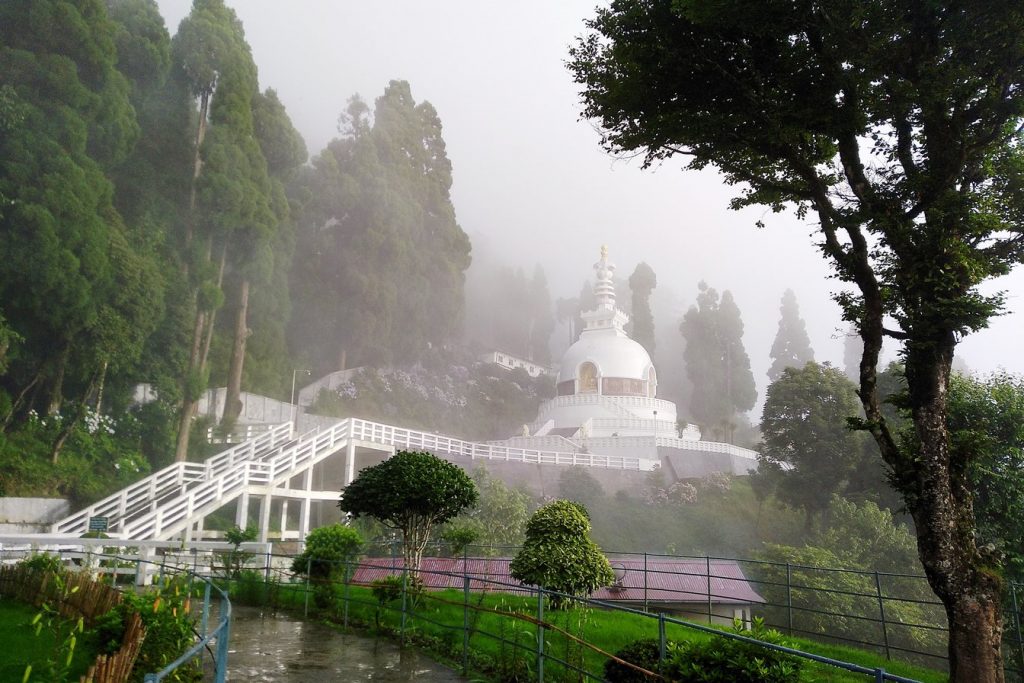
The Japanese Peace Pagoda stands on the slopes of Jalapahar hill, south of the main town centre. Built under the guidance of the Nipponzan-Myohoji Buddhist Order, the site comprises two distinct structures: the outdoor peace pagoda itself and an adjoining two-storey Japanese Buddhist temple.
For travellers spending time in Darjeeling, the site offers a look into twentieth-century Japanese Buddhist design and the daily routines of the Nipponzan-Myohoji order. The grounds are open through the week, and visitors come to view the architecture, walk the perimeter of the monument, or sit in on the scheduled drum prayer sessions.
History of the Pagoda
The pagoda traces its origins to the post-war peace pagoda movement led by Nichidatsu Fujii (1885–1985), a Japanese Buddhist monk and founder of the Nipponzan-Myohoji order. Fujii arrived in Calcutta in January 1931 and took up gyakku shodai — walking through the town chanting while beating a hand drum. That practice is the direct ancestor of the drumming visitors hear at the Darjeeling temple today.
Fujii later met Mahatma Gandhi and gave him a statue of the three wise monkeys, which Gandhi went on to make famous in India. But Fujii himself traced his turn to nonviolence not to that meeting but to 1945. In his own words, it was “because the atomic bomb was dropped on Hiroshima and Nagasaki.”
That response took physical form soon after the war. The first peace pagoda, on Mount Hanaoka in Kumamoto, was begun in 1947 using hand tools and inaugurated in 1954; by 2000 at least 80 peace pagodas had been built worldwide under the movement Fujii founded. The Rajgir World Peace Pagoda in Bihar, another Fujii project, was completed in 1969, its dedication timed to the centenary of Gandhi’s birth, and it pairs a pagoda with a Nipponzan Myohoji temple in the same layout Darjeeling later followed.
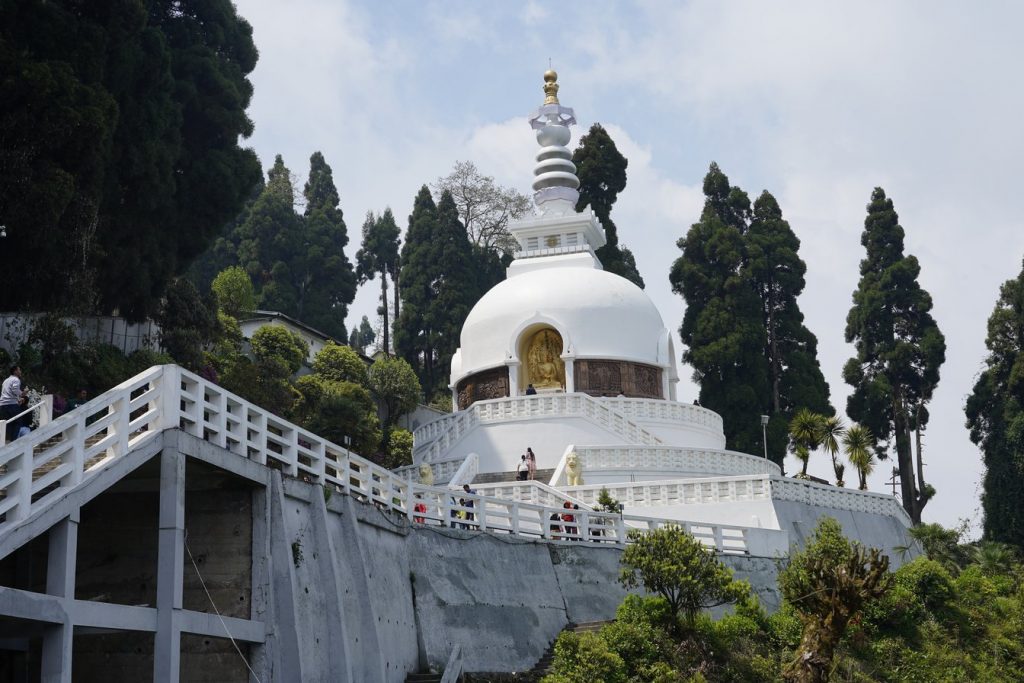
Work on the Darjeeling site began on 3 November 1972, when Fujii laid the foundation stone. The Darjeeling district administration’s tourism page records that the pagoda was designed by the architect M. Ohka, that it was inaugurated on 1 November 1992, and that it houses the four avatars of the Buddha, including the Maitreya Buddha.
Structure and Dimensions
The pagoda is described as the tallest free-standing structure in Darjeeling. Its dimensions:
- Height: 28.5 metres (94 ft)
- Diameter: 23 metres (75 ft)
The structure consists of a wide circular base rising into a domed profile that tapers toward a spire, set against the slope of Jalapahar hill. A walkway around the base lets visitors view the monument from all sides.
The Adjoining Japanese Temple
Directly beside the pagoda stands the Nipponzan Myohoji Temple — a separate two-storey white Japanese-style Buddhist temple building that serves as the daily focal point for the resident monks.
Where the peace pagoda is an outdoor stupa built for circumambulation, the temple building is where the community holds its formal devotional life. Inside, it houses a Buddha statue and a portrait of founder Fujii Guruji. It is also where the daily morning and evening prayer sessions take place.
Visitors may enter the temple building during opening hours, and are expected to remove their shoes at the entrance.
Visiting Practicalities: Timings, Prayers and Entry
Peace Pagoda Darjeeling Timings
- Daily opening hours: 4:00 AM to 7:00 PM
- Morning prayers: approximately 4:30 AM to 6:00 or 6:30 AM
- Evening prayers: approximately 4:30 PM to 6:00 or 6:30 PM
During prayer times the monks beat a large traditional drum, the Ho-ko, while chanting — the same gyakku shodai practice Fujii carried through Calcutta’s streets in the 1930s. Visitors who come in during these hours may sit quietly on the floor mats and observe; the morning session is usually the quieter of the two.
Hours, prayer times and the entry fee below were checked in September 2026 and can shift, so confirm locally before you travel.
Entry Fee
There is no charge to enter the grounds, the outdoor pagoda or the adjoining temple.
How to Reach Jalapahar Hill
The site sits on the slopes of Jalapahar hill, roughly 2 to 2.5 km from central Darjeeling and the Darjeeling Himalayan Railway station.
By Road
A drive from central Darjeeling covers 2 to 2.5 km and takes roughly 10 minutes by local taxi, depending on town traffic. Taxis generally drop passengers near the entrance gate, from where a paved walkway leads up through the grounds.
On Foot
A pedestrian trail climbs from Chowrasta and Mall Road, taking about 45 minutes of steady, uphill walking. The path follows the ridge of Jalapahar, so wear comfortable walking shoes. It’s a reasonable way to combine the walk with exploring Darjeeling on foot rather than by taxi.
A Practical Base: Hotel Apsara
For travellers organising a trip to the Peace Pagoda and the other Jalapahar sights, Hotel Apsara offers a central, practical base.
Hotel Apsara is a pure vegetarian hotel at 6 Laden La Road, Chauk Bazaar, Darjeeling, West Bengal 734101, near the Head Post Office in Darjeeling Bazar. The hotel is a few minutes’ walk from Mall Road, putting central restaurants, tea shops and transport within easy reach.
The driving distance from Hotel Apsara to the Japanese Peace Pagoda is 2.4 km, which puts guests within easy range of Jalapahar hill for an early prayer session or a late-afternoon visit.
The hotel offers six room types, with published indicative rates from ₹3,723 to ₹6,585 per night. These are the hotel’s own published, indicative rates rather than a guaranteed tariff for any given date.
Guests who want extra space and a mountain outlook can look at the Super Deluxe Room with Mountain View, which is 320 sq ft, has a mountain view, and is published at ₹5,581 per night.
To see the full range, visit Hotel Apsara’s rooms. If you have specific dates in mind, get in touch to plan your visit directly with the hotel.