

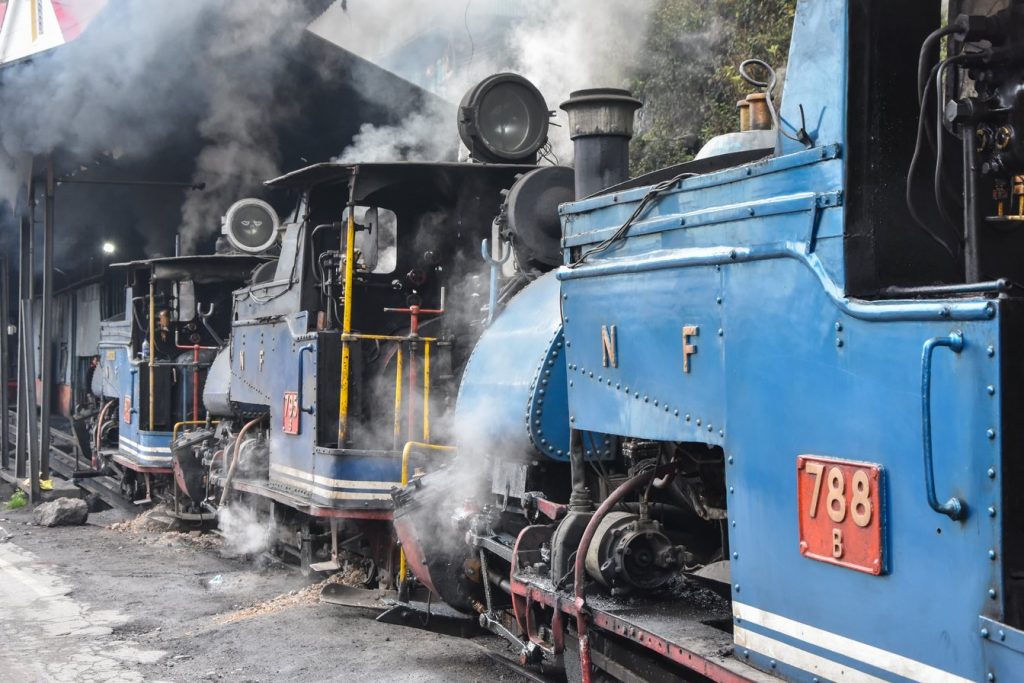
The Darjeeling toy train is one of the few railways in the world people ride for the ride itself rather than to get somewhere. It creeps along the road on a narrow track, loops around a war memorial, and stops at the highest railway station in India — all within a couple of hours. Most visitors experience it as a short joy ride from Darjeeling to Ghum and back, and that is the version worth planning for.
A quick note before the detail below: fares, timings and booking rules for the toy train were checked in September 2026 and change often. Confirm the current figures locally before you travel.
A UNESCO World Heritage railway
The Darjeeling Himalayan Railway (DHR) was inscribed as a UNESCO World Heritage Site in 1999, recognised under criteria (ii) and (iv) for its role in the region’s transport-driven development and as an example of 19th-century railway engineering. UNESCO’s own decision on the inscription notes that the DHR was the first industrial heritage site in Asia added to the World Heritage List. It was later grouped with two other Indian hill railways: the Nilgiri Mountain Railway, added in 2005 (the combined listing renamed “Mountain Railways of India”), and the Kalka–Shimla Railway, added in 2008.
The DHR runs on a 610 mm (2 ft) narrow gauge — genuinely tiny compared with a standard Indian Railways line, which is part of why it is nicknamed the “toy train.” The full historical route between New Jalpaiguri (NJP) and Darjeeling covers around 88 km, climbing from roughly 100 m above sea level at NJP to about 2,200 m at Darjeeling. UNESCO’s own documentation of the line describes six zig-zag reverses and three loops along the climb.
How the line was built
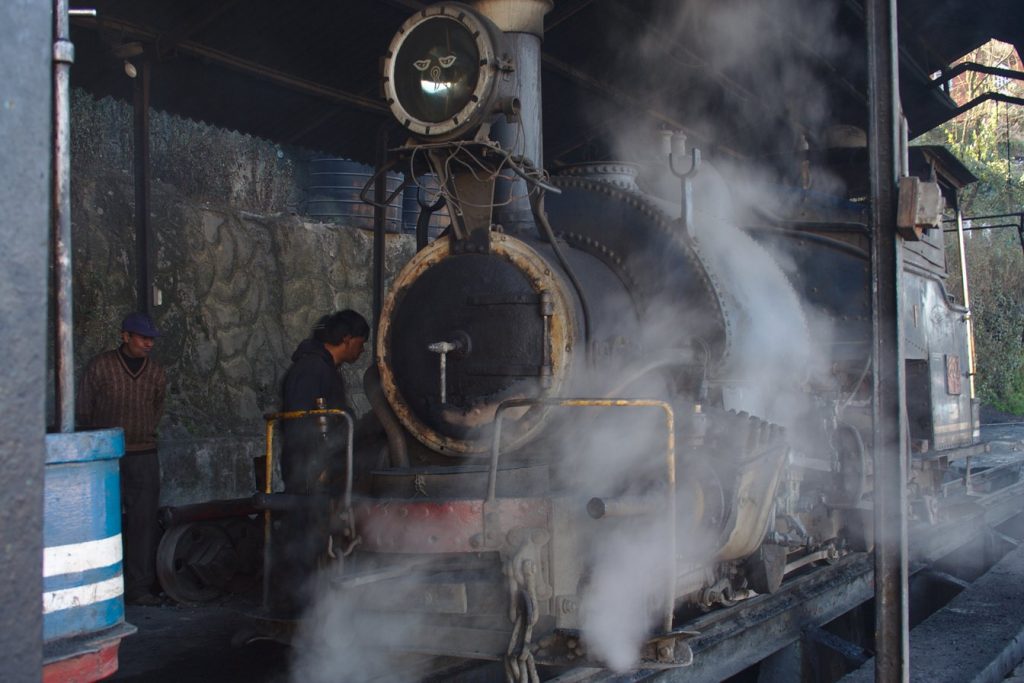
Railway-history records describe how Franklin Prestage, Agent of the Eastern Bengal Railway Company, proposed a steam tramway from Siliguri to Darjeeling to the Government of Bengal in 1878; a committee under Lieutenant-Governor Sir Ashley Eden accepted the scheme in 1879. Gillanders, Arbuthnot & Co, one of the oldest firms in Calcutta, were appointed agents and built the line, reaching Tindharia by March 1880 (Lord Lytton, the first Viceroy to visit Darjeeling, rode that far) before opening through to Darjeeling in July 1881. Grace’s Guide records the first eight engines as unsuitable 0-4-0 tanks from Sharp, Stewart and Co; the B-Class saddle-tanks that replaced them are generally dated 1889–1925, from Sharp, Stewart and later the North British Locomotive Company. The tightest bend, known to railwaymen as “Agony Point,” lies near Tindharia and Gayabari, where the railway’s workshops also sit. Heavy rain in 1902 reportedly washed away the Teesta bridge, with services kept going by transhipping across the breaks; the line was later closed eighteen months during the 1988–89 Gorkhaland agitation.
Mark Twain rode the DHR up from the plains in February 1896, his diary entry dated 15 February, and wrote in Following the Equator (1897): “The railway journey up the mountain is forty miles, and it takes eight hours to make it.” He then came back down 35 miles of the line on a small canvas-canopied hand-car with no engine, relying on its brake, and called it the most enjoyable day he had spent on earth.
The Darjeeling–Ghum joy ride
What most visitors actually book is the short DHR joy ride, running from Darjeeling to Ghum and back. It takes roughly 2 hours round trip, covering about 14–15 km, and includes a stop of around 25–30 minutes at Ghum station and about 10 minutes at Batasia Loop, around the Gorkha War Memorial garden.
Both steam and diesel locomotives run the joy ride, and fares differ between them. Sources do not agree on a single current figure for either, so treat these as approximate ranges rather than fixed prices: the steam joy ride has been quoted anywhere from around ₹1,050 to ₹1,600 per adult round trip depending on class and source, while the diesel joy ride runs cheaper, from around ₹600 to ₹1,000.
Departure times vary between sources and generally increase in the high season, so check the current timetable locally or via IRCTC close to your travel date.
Worth knowing around Durga Puja: from 1 October 2026 to 3 January 2027, DHR adds festive-season extras alongside the regular joy ride — four one-way diesel Darjeeling–Ghum trips at ₹800, plus a steam-hauled “Red Panda” round trip (₹1,530) and a diesel “Muktadhara” round trip (₹1,030), both on the separate Kurseong–Mahanadi section.
Steam, diesel, and the full NJP–Darjeeling passenger train
If you want to see the whole climb rather than the short Ghum loop, DHR also runs a full passenger train between New Jalpaiguri and Darjeeling — trains 52541 and 52540. It is a long journey, roughly 7 to 8 hours one way, and delays from landslides or track issues are not unusual.
The joy ride’s steam-hauled runs use vintage British-built B-Class locomotives, and the DHR itself is administratively part of the Northeast Frontier Railway (NFR), a zone of Indian Railways.
Ghum station and the DHR museum
Ghum station sits at roughly 2,258–2,260 m, the highest railway station in India — though not, despite what some tourist literature claims, the highest in the world. There is a DHR museum on or beside the Ghum platform, and joy-ride passengers get roughly 25–30 minutes there as part of the standard stop. If visiting Ghum independently, check locally for opening hours and entry charges, as no figures for a stand-alone visit could be confirmed here.
Booking tickets and practical tips
Tickets can be booked online via IRCTC, at any computerised Indian Railways reservation counter across the country, or directly at the Darjeeling station ticket counter, often the simplest route off-season. How far in advance you can book varies by source, so check current IRCTC booking rules rather than assume a fixed window.
Seats on the joy ride are limited and it is popular, so book ahead, especially in the clearer months. Dress in layers — open sections and window seats get cold as the train climbs.
Where to stay for easy access to the toy train
If riding the toy train is a priority, staying close to the station cuts out a lot of the morning logistics. Hotel Apsara is a pure vegetarian hotel at 6 Laden La Road, Chauk Bazaar, Darjeeling 734101, near the Head Post Office in Darjeeling Bazar.
By MakeMyTrip’s measured distances, the hotel is an 8-minute, 550 m walk from Darjeeling Railway Station, and a 6-minute, 560 m walk from the toy-train Joy Ride station specifically — close enough to walk to on the morning of your ride. If your itinerary also takes in Batasia Loop or Ghum, the hotel is a 4.4 km drive from Batasia Loop and a 7.3 km drive from Ghoom Railway Station, both per MakeMyTrip.
The hotel is also a few minutes’ walk from Mall Road — MakeMyTrip’s own measured figure is roughly 470 m, a 6-minute walk. Multilingual staff who speak Bengali and English are useful for sorting out ticket questions or last-minute directions to the station, and the 24-hour reception means an early joy-ride departure is not a problem to arrange. Its multi-cuisine vegetarian restaurant serves Indian vegetarian food prepared by an Indian chef, with a kid’s menu available — useful if you want a meal before or after your ride.
Check-in is at 1:00 PM. Check-out time is not settled across sources (11:30 AM and 12:00 PM both appear), so confirm it when you book. The Deluxe Double Bedroom sits at the bottom of a published range running to ₹6,585 across the six room types. Those figures are indicative, so check what applies to your dates.
For a base within walking distance of both the railway station and the toy-train stop, Hotel Apsara is a straightforward option to build a Darjeeling toy train morning around.